 Lingerieinfo
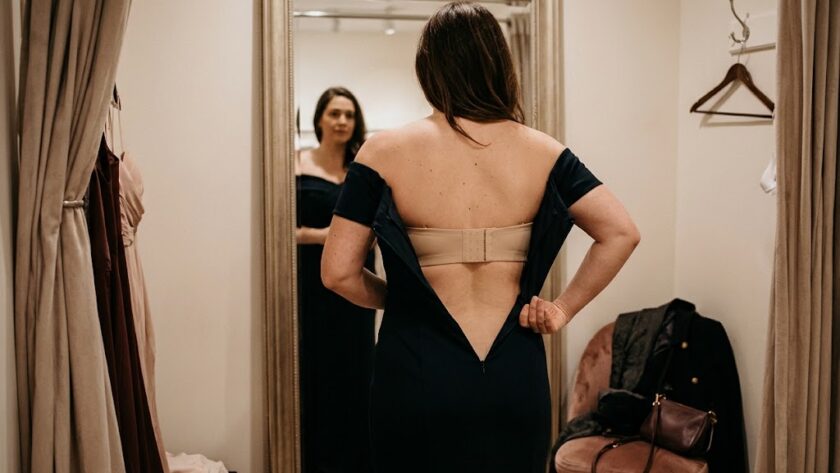
Anyone wearing a cup size E, F, G, or beyond knows the routine: a stunning off-the-shoulder dress hangs in the wardrobe,while immediate dread sets in: “This will end up around my waist within an hour.” Women with fuller busts frequently abandon bardot necklines and open-shoulder cuts because previous strapless bras offered zero staying power.
The problem rarely lies in your body or breast shape. In nearly every instance, poor garment engineering or an incorrect band size is to blame. A properly designed strapless bra provides rock-solid support even for heavy busts, whereas an inadequate model slips down even on a B-cup.
The Physics of Strapless Support: What Keeps It in Place?
In a conventional bra, shoulder straps carry roughly 10% to 15% of the breast weight. When straps are eliminated, the entire load transfers to two primary components: the underbust band and the underwires. A strapless bra cannot simply rest against the chest; it must be firmly anchored to the ribcage.
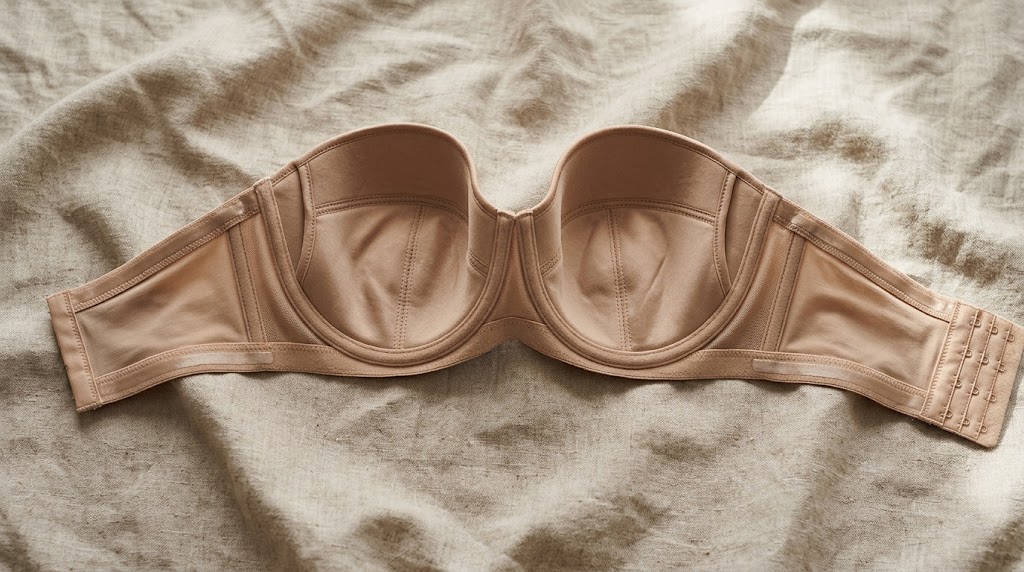
Three fundamental rules of strapless engineering:
- The underband is the foundation: If the band is too loose, silicone grips cannot overcome gravity.
- Upward and inward support vectors: Structural lift must originate from beneath and the sides rather than compressing the tissue flat against the chest.
- Continuous flush contact: The band and the center gore must sit completely flush against the sternum and ribs.Any gap creates leverage, prompting the bra to shift downward.
Structural Features Engineered for Fuller Busts (DD+)
| Construction Feature | How It Works | What to Look For |
|---|---|---|
| Multi-Part Cut-and-Sewn Cups (3+ Panels) | Vertical and diagonal seams shape rigid fabric into a supportive cup, lifting heavy tissue without flattening. | The upper cup edge must not cut into breast tissue, preventing the „quad-boob” effect. |
| Wide Underband (3–5 Hook Rows) | Expanded surface area distributes pressure across the ribcage without digging into skin. | Ensure the high side wings do not ride up into the armpits beneath tailored armholes. |
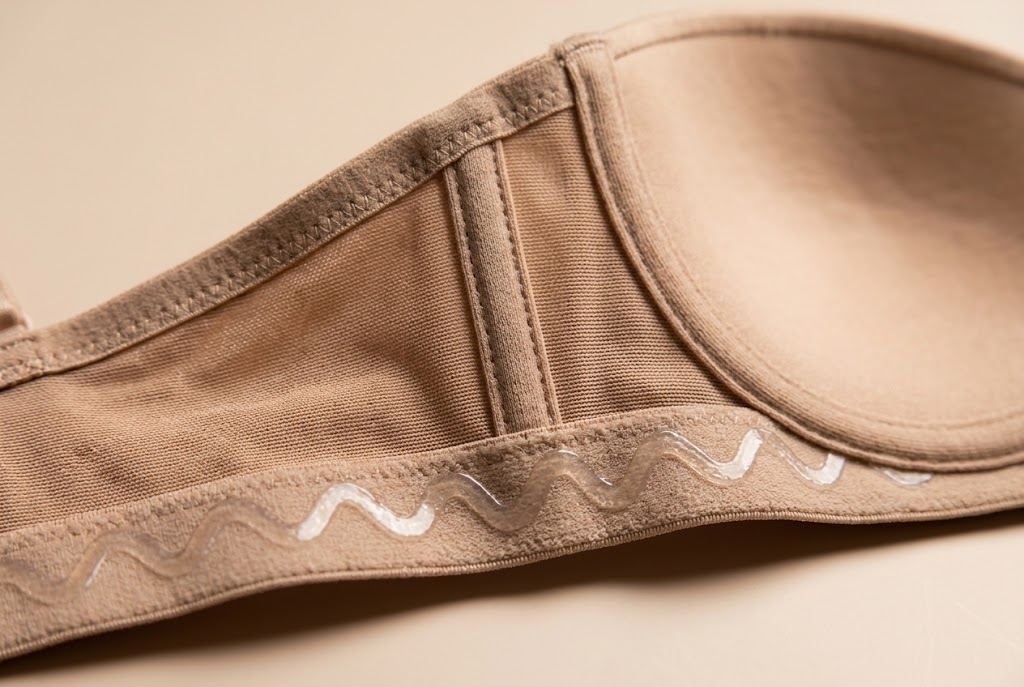
| Silicone Gripper Ribbons | Medical-grade silicone strips along the top and bottom hems generate friction against the skin. | Apply exclusively to completely dry skin; body lotions and oils break down silicone friction instantly. |
| Vertical Side Boning (Stays) | Flexible internal bones integrated into side wings prevent the band from buckling or rolling. | Boning must flex naturally with body movement without digging into the ribcage or hips when seated. |
| Longline / Basque Silhouette | Extended fabric down the torso shifts anchor points toward the waistline for maximum stability. | Thicker construction may show through ultra-lightweight silk or tight jersey garments. |
What to Avoid with a Fuller Bust
- Seamless Elastic Bandeaus: Lacking underwires, structured cradles, and bridge support, tube-top styles simply flatten larger breasts and stretch out quickly.
- Narrow Bands with 1–2 Hook Closures: Narrow elastic bands lack the mechanical tension required to counterbalance heavy bust tissue, collapsing into a rolled cord.
- Shallow Molded Foam Cups: Rigid, shallow t-shirt cups cannot accommodate the natural projection of fuller breasts, pushing the underwire away from the ribcage.
How to Determine the Correct Size for a Strapless Bra
Sizing a strapless bra requires a stricter approach than purchasing everyday lingerie:
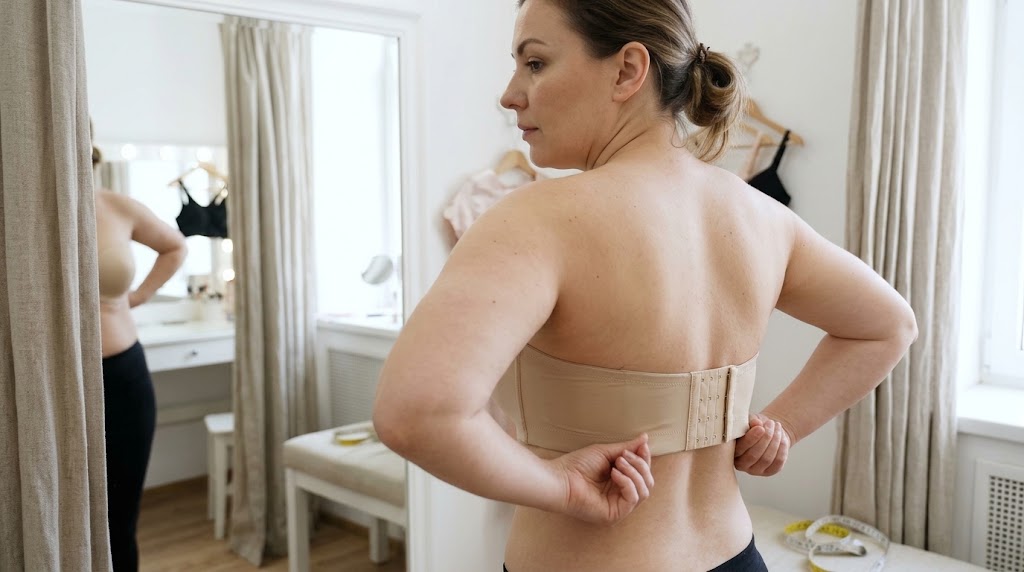
- The band must anchor on the loosest hook:Always fit a brand-new bra on the loosest hook-and-eye setting. It should feel very snug with firm resistance,without restricting breathing. If a new strapless model must be fastened on the tightest hook to stay up, the band is too loose; as elastics naturally stretch with wear, no adjustment leeway will remain.
- Utilize Sister Sizing:When dropping down a band size for firmer anchorage, step up one cup size (e.g., transition from 36DD / 80F to 34E / 75G). This preserves cup volume while securing the underband tightly against the ribcage.
- Flush Center Gore and Enclosing Wires:The bridge between the cups must lie flat against the sternum. If it floats, the cups are too small or too shallow. Side wires must fully encapsulate breast tissue, pointing back toward the center of the armpit rather than resting on breast tissue.
The 5-Step Fitting Room Movement Test
Before detaching tags, conduct a dynamic movement test:
- Overhead Reach: Raise both arms fully overhead, then lower them. The underband must remain stationary without sliding downward.
- Forward Bend: Bend forward at the waist, gently shake your shoulders, and stand upright. Breast tissue must remain securely inside the cups without spilling over.
- Bounce Test: Perform two light jumps in place to simulate dancing or brisk walking.
- Seated Check: Sit down on a chair. The torso expands slightly when seated; ensure side boning does not buckle sharply or pinch into the ribs.
- Under-Garment Fitting: Try the bra underneath the exact garment intended for wear to evaluate opacity and edge concealment.
Proven Full-Bust Strapless Models
Specific designs widely recognized by professional brafitting specialists include:
- Curvy Kate Luxe Strapless: Engineered with reinforced inner sling panels, offering support up to UK J cups.
- Panache Evie / Porcelain Elan: A classic British balcony construction featuring strong underwires, side boning,and firm underbands.
- Wonderbra Ultimate Strapless: Features patented internal polycarbonate hand-shaped supports instead of classic wires, catering to deep plunge necklines.
Frequently Asked Questions (FAQ)
Can a strapless bra genuinely support a large bust?
Yes. Support relies primarily on a firm, correctly sized underband and integrated vertical boning, which collectively distribute the bust weight. When properly engineered, a strapless bra remains anchored without requiring constant adjustments.
Why do silicone strips fail to keep my bra up?
Silicone strips increase surface friction, but cannot compensate for an oversized underband. Furthermore, applying body lotion, moisturizer, or oils directly before wearing lubricates the skin, preventing silicone from gripping.
Should I purchase a smaller band size than my standard bra?
In most cases, yes. Because straps are absent, the band must generate all upward support. Dropping one band size and going up one cup size (sister sizing) is standard brafitting protocol for strapless models.
How should a strapless bra be washed to protect the silicone?
Wash strapless bras by hand in lukewarm water using a gentle, alcohol-free detergent. Machine cycles and fabric softeners deteriorate silicone coatings and warp internal boning. Lay flat to dry away from direct heat sources.