



All voices matter
All voices matter

Your Daughter’s First Bra: The Guide No One Ever Gave You
Share your love
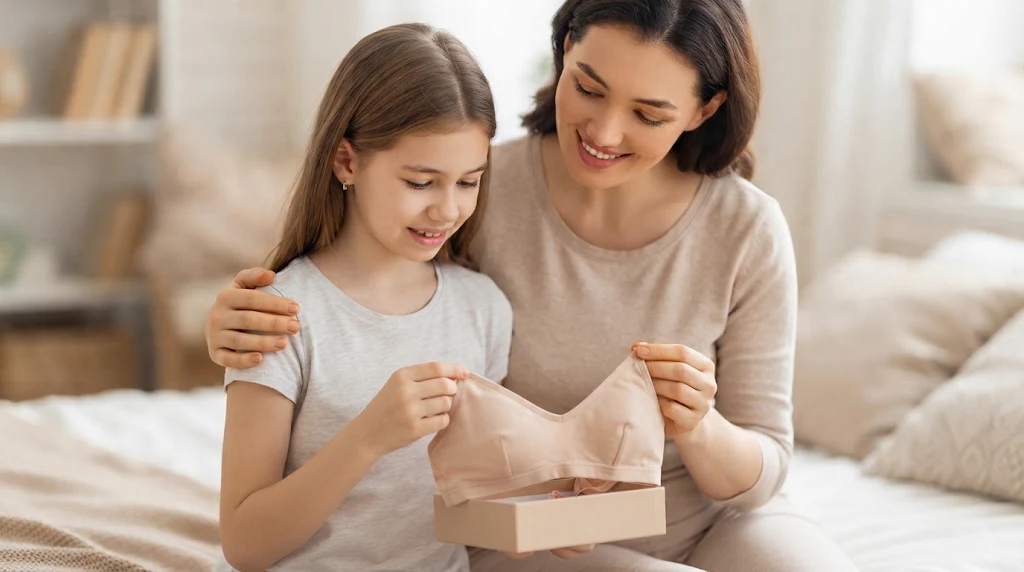
Most guides about a girl’s first bra end with a size chart. Yet for a young girl, this isn’t just a clothing purchase—it’s one of the first moments adults show her how to treat her own body: with calm, without shame, and with the right to make her own choices. How this moment goes often stays in her memory for years.
In this guide, you’ll find what people usually don’t write about: what is normal in breast development (and when to see a doctor), why a sports bra is often more important than a “regular” one, how to handle school uniforms and gym locker rooms, what to do if your daughter can’t stand tags and seams, and how to talk without awkwardness—for her or for you.
Body First, Then the Bra: What is Normal
The first visible sign of puberty for most girls is the breast bud—a small, firm lump right under the nipple. For 95% of girls, this appears between ages 8 and 13. The range is huge, and both extremes are entirely normal.
What to know before you buy anything:
- One breast often starts growing before the other. Asymmetry at this stage is typical and usually evens out over time. Girls get very scared of this—tell her about it before she notices on her own.
- The bud can be tender or hurt to the touch, like when bumped by a ball or during a hug. This is normal. A soft,lightly covering top brings relief at this exact stage.
- Do not squeeze or “check” the lump. Doctors advise against manipulating the breast bud.
- When to see a pediatrician? If breasts start developing before age 8, if the lump is red, hot, or very painful, or if anything worries you. Early development is often a harmless variant of normal, but a doctor should evaluate it.
A good conversation starts with: “What’s happening to your body is normal.” Only then: “Do you want us to look for something comfortable?”
When to Buy: Signals, Not Age
There is no “right age.” There is the right moment, and your daughter and her body dictate it. A first bra makes sense when:
- breasts or nipples show through her shirt and it bothers her,
- she feels discomfort or pain during running, jumping, or physical education (PE),
- she starts slouching, wearing hoodies in hot weather, or crossing her arms over her chest—often a silent sign of self-consciousness,
- she asks for one herself because her friends are already wearing them.
This last point matters: if your daughter wants a bra even though “there isn’t much to support yet,” that’s reason enough.For her, it’s about group belonging and a sense of security, and a soft top won’t harm her. Conversely: if breasts are growing but she isn’t ready, don’t force it. Leave one comfortable top in her drawer and tell her it’s there whenever she’s ready.
How to Talk Without Shame
The biggest mistake is talking “on the fly”—at the dinner table, in front of siblings, or grandparents. Choose a one-on-one moment: a walk, a car ride (sitting side-by-side, not face-to-face, which makes talking much easier for kids), or bedtime reading.
Phrases that open doors instead of closing them:
- “I remember when I got my first bra. Would you like us to go look together sometime?”
- “Some girls wear soft tops under their shirts now because it’s more comfortable for sports. If you’d like, we can buy one.”
- “You don’t have to answer now. Come back to me whenever you’re ready.”
What to avoid: comments about appearance (“look how much you’ve grown,” “finally something is showing”), talking in front of others, or informing family members (“you know, our little girl is wearing a bra now”). Even an aunt’s well-meaning comment at dinner can make a girl hide her body for months.
What if it’s just a dad at home? That’s no problem. Keep a matter-of-fact tone, just like buying sports shoes: “I see you could use a comfortable top for sports. You can pick one online yourself, and I’ll pay.” You can also ask a trusted female relative or a professional bra fitter in a salon for help—it’s their daily job.
Sports: The Topic Almost No One Discusses
This is the most crucial part of this guide. Researchers from the Research Group in Breast Health at the University of Portsmouth studied over 2,000 girls aged 11–17. The findings are striking:
- about half of girls may avoid sports due to shame or breast pain during exercise,
- three-quarters had at least one breast-related concern: embarrassment in the locker room, breast bounce during exercise, or pain,
- over half never wore a sports bra, and only 10% always wore one,
- concerns peaked around age 14,
- girls with larger busts dropped out of activity more frequently.
Researchers emphasize that a properly fitted sports bra restricts breast movement just as effectively for small and large busts alike, and the problem is largely resolved through education during puberty.
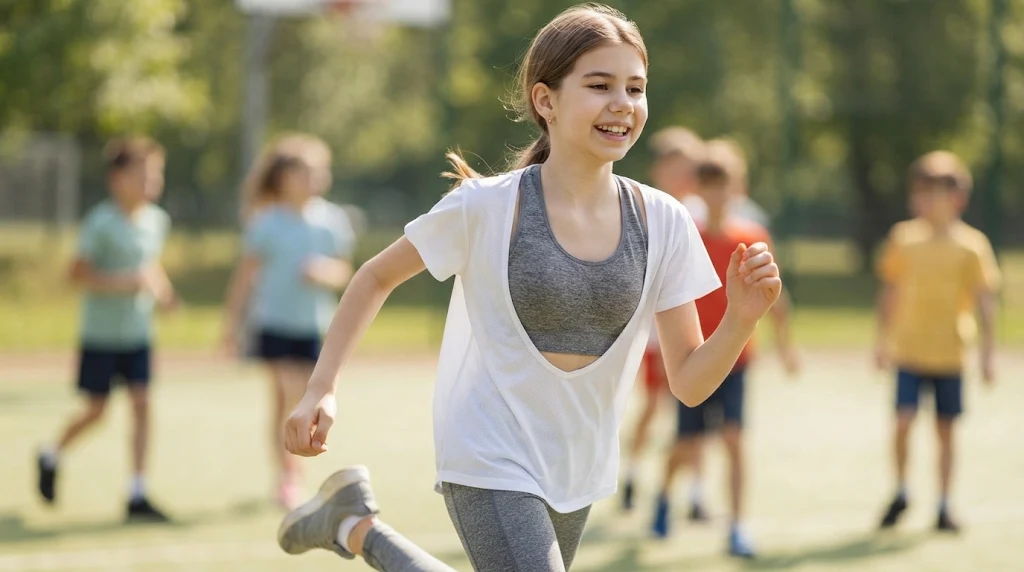
What does this mean in practice? If your daughter suddenly “dislikes” sports, keeps getting medical exemptions, or wants to quit dance or soccer, ask gently if she is bothered by how her body moves. For many girls, a sports bra should be the first bra, not an accessory bought “someday.” It could decide whether she stays active for the rest of her life.
School, Locker Rooms, and Extracurricular Activities
These situations cause the most stress.
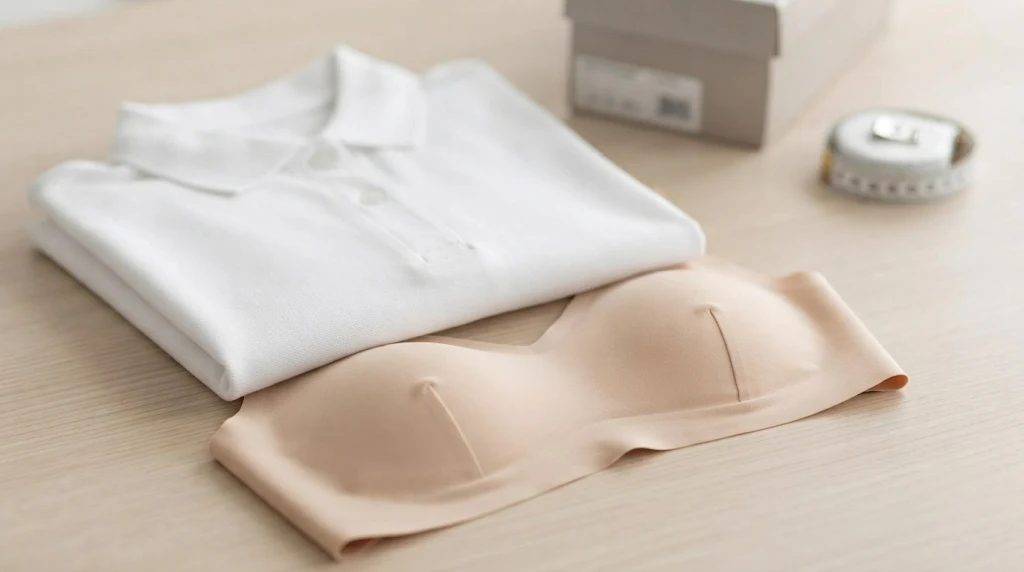
- School uniforms and formal dress codes. A white bra under a white shirt is the most visible. For formal events,exams, and ceremonies, the best choice is a smooth, seamless top close to your daughter’s skin tone (a “nude” shade matched to her, not a single universal beige). Buy it in advance, not the night before an event.
- The PE locker room. The biggest stress is changing clothes in front of peers. A simple trick: on sports days, your daughter puts on her sports bra at home under her regular clothes. In the locker room, she only changes her shirt and doesn’t have to fasten anything in front of others.
- Camps and school trips. Pack one more piece than seems necessary, plus a dedicated sports bra for physical activities. Make sure your daughter knows how to fasten and adjust straps on her own—practice this at home.
- Swimming pool. Choose a swimsuit with a built-in lining or a light inner top. Thin, single-layer fabrics can become an unpleasant surprise when wet.
Which Model to Start With: The Stages Map
The first bra should be comfortable and provide a sense of coverage. It is not meant to “shape” or enlarge anything.
| Stage | What to choose | Why |
|---|---|---|
| Bud, tenderness | Top or undershirt with a double layer of fabric on the chest | Covers sensitive areas; nipples don’t show through clothing |
| Visible growth | Soft bralette without underwires, with a wide under-bust band, optionally with thin removable pads | Light support without pressure; pads provide discretion |
| Physical activity | Low- or medium-support sports bra | Restricts movement and pain during running and jumping |
| Defined cups | First bra in a specific size, e.g., 65A, with soft cups | Adapts to shape rather than just “S, M, L” |
At the start, push-up models, heavily padded cups, and underwires are not needed. If your daughter ever wants an underwired bra later, let it be her choice, not the “next mandatory step.”
Size: How to Measure at Home in 5 Minutes
Many girls prefer to measure themselves. Give her a soft tape measure and instructions, and step out of the room.
- Under-bust band: Tape measure horizontal, right under the breasts, snug but not digging in. Round to the nearest band size: 60, 65, or 70.
- Bust measurement: Tape measure loose, at the fullest part, across the nipples, on an exhale.
- The difference between measurements roughly indicates the cup size. In first bras, this is usually AA or A. For the smallest differences, simply choose a children’s size top (by height, e.g., 146, 152, 158) or S/M.
How to check if it fits:
- two fingers fit under the band, and the band doesn’t ride up in the back,
- fasten a new bra on the loosest set of hooks—as it stretches over time, you can tighten it,
- straps neither dig in nor slip off,
- your daughter can raise her arms, jump, and bend over without adjusting it.
Check the size every 3–4 months. During puberty, the body changes fast, and a bra that is too tight compresses growing tissue and discourages wearing it. If results are unclear, visit a professional bra-fitting salon—a good fitter knows how to work with teens.
When Your Daughter Can’t Stand Tags and Seams
This topic is almost entirely absent from guides, yet it affects many families—especially girls with sensory sensitivities,autism spectrum, or ADHD. For them, a bra can be a source of genuine torment rather than a whim.
- Look for seamless models or those with flat seams and printed tags instead of stitched ones.
- Choose soft cotton, modal, or microfiber without scratchy lace.
- Pull-on tops (without back closures) are often better tolerated than hooks.
- Wash before the first wear—the fabric softens, and production residues are washed away.
- Buy just one piece to try first. Let her wear it at home for a few hours before buying more.
- Let her touch the fabric in the store. She knows best what is “unbearable.”
Shopping: Privacy, How Many Pieces, and Budget
- In-store: Your daughter goes into the fitting room alone. You wait outside and ask only: “Should I grab another size?” Do not enter without permission, do not pull back the curtain, do not call out to the sales assistant across the store. If it’s a specialized bra-fitting salon, ask your daughter if she prefers you inside or outside.
- Online: Often better for starters: zero audience, calm trying-on at home. Order two neighboring sizes and return the one that doesn’t fit. Check return policies beforehand.
- How many pieces? A reasonable starter set is three: two everyday ones (one to wear, one in the wash), including one in a skin tone for light clothing; and one sports bra.
- Let her choose at least one entirely on her own—color, pattern, print. A small decision, but it gives a sense that this is her business, not mom’s project.
- Do not buy in bulk or expensive items. In a few months, the size may change. Quality materials, a wide under-bust band, and adjustable straps matter more than the brand.
Myths That Still Circulate
- “A bra accelerates or stunts breast growth.” False. Hormones and genetics determine development speed, not underwear.
- “You need to wear a bra as early as possible so breasts don’t sag.” Everyday wear is about comfort and convenience, not a medical requirement. Sports are different: Portsmouth researchers note that without support,intense movement can strain delicate breast ligaments. That’s why a sports bra makes sense regardless of size.
- “Small breasts don’t need a sports bra.” They do if your daughter feels discomfort. Pain and self-consciousness do not depend on cup size.
- “You need to sleep in a bra.” There is no such need. Nighttime is when the body can rest from any constriction.
- “Underwires are harmful.” There is no credible evidence linking underwires to breast diseases. For a first bra, we advise against them simply for comfort: growing tissue and metal wires rarely get along.
What Not to Do: A Short List
- Don’t comment on bodily changes in front of others—neither siblings, grandparents, nor on social media.
- Don’t make jokes about size—neither “too small” nor “too big.”
- Don’t project your own insecurities (“I hope you don’t end up with breasts like mine”).
- Don’t buy in secret and slip it into her drawer without a word—it looks like a taboo subject.
- Don’t force wearing one if she isn’t ready, and don’t refuse if she really wants one.
- Don’t post photos from shopping trips or “the big day.” It’s her privacy.
- Don’t assume one conversation is enough. Leave the door open: “If anything rubs or feels too small, let me know.”
Sources & References:
- University of Portsmouth, Research Group in Breast Health: Breasts putting girls off sport? (ScienceDaily, 2016)
- Half of British schoolgirls avoid sport because of breasts, study finds (News-Medical)
- Scurr J. et al., The Influence of the Breast on Sport and Exercise Participation in School Girls in the United Kingdom, Journal of Adolescent Health
- Stony Brook Medicine, Early Puberty – age of breast bud development
- RACGP, The assessment of premature thelarche (2025)
Disclaimer: This article is for informational purposes only and does not replace professional medical consultation.