 Lingerieinfo
 Collagen in the label. Silver ions in the waistband. “Ice silk” meant to cool your skin on a scorching hot day. Graphene—because if it works in space, why not in a bra? If you’ve recently browsed through the catalogs of popular lingerie brands, you’ve almost certainly noticed how much product descriptions have begun to resemble pharmacy leaflets rather than tags on basic cotton underwear. And I doubt I’m alone in this—the more of these descriptions I read, the more often I catch myself asking: has anyone actually tested this, or did someone in the marketing department just have a creative day?
I decided to investigate. Not as an opponent of new textile technologies—because those certainly exist and can be genuinely valuable—but as a consumer who wants to know what she is actually paying for when the price of “regular” underwear suddenly jumps by a dozen dollars due to a single magic word on the tag.
Where Did the Obsession with “Miracle Ingredients” Come From?
This phenomenon isn’t accidental, nor is it limited to underwear—it is part of a much broader trend that researchers from RMIT University (Emma Lynas, Rebecca Van Amber, and Juliana Luna Mora) described in a 2024 academic study titled “Fibre Fantasies: A Critical Examination of Wellness Claims in Textile Marketing.” The authors directly label this phenomenon as a form of greenwashing and “wellness-washing”—textile brands, faced with growing consumer interest in health and well-being, resort to vague or misinterpreted scientific claims to sell ordinary apparel as something extraordinary. The key word here is “mystification”—the narrative constructed around the product is designed to sound scientific, but it is rarely verifiable.
And this brings us to lingerie, which serves as uniquely fertile ground for such messaging. After all, nothing sells better to women than the promise that an everyday item will simultaneously care for our health, beauty, and comfort. We don’t have to look far—take the widely publicized case of American brands Wacoal and Maidenform, documented by Boston University. Both companies advertised their shapewear (iPant and Flexees Instant Slimmer, respectively) as products containing “embedded minerals and nutrients” that would penetrate the skin and literally melt away body fat. The case ended up in court through a class-action lawsuit for consumer protection violations, and Maidenform—as reported by the university portal—ultimately admitted that its fabric supplier might not have been able to substantiate the advertised features. This isn’t an isolated case from a decade ago that lost its relevance; it is the exact same mechanism we see today in descriptions of underwear featuring “collagen” or “ceramides.”
Collagen in Underwear? Science Says: “Prove It”
Speaking of collagen—it is perhaps the most dramatic example of marketing running far ahead of science. Testing and certification firm Intertek had to develop a specialized, first-of-its-kind testing method for “collagen fabric,” which is increasingly used in underwear and activewear. The mere fact that an independent laboratory had to invent a protocol just to detect whether there is any collagen in the fabric at all speaks volumes—it means the market was flooded with product claims that no one had ever systematically verified.
And when someone did check, things got uncomfortable for the manufacturers. In California, a federal court case was brought against a cosmetics brand advertising a product as “C + Collagen.” The court ruled that a company cannot arbitrarily redefine the word “collagen” for its own convenience when a precise, scientifically accepted definition already exists—a protein found exclusively in animal organisms. The manufacturer tried to defend itself by claiming the existence of “plant-based collagen-like amino acids,” but the court dismissed it as an assertion unsupported by credible science. Sound familiar? It is the exact same tactic seen today on underwear tags claiming “firming properties thanks to collagen”—because even if microscopic protein particles are present in the yarn, there is no evidence that in such forms and quantities they can be absorbed through the skin to make any real difference to its firmness.
Ubras and the Art of Building a Brand on Slogans, Not Evidence
It is impossible to write about lingerie marketing without mentioning Ubras—the Chinese brand that built a massive presence within a few years as one of the most popular manufacturers of “seamless, one-size-fits-all” bras, dominating the Chinese market before expanding globally via platforms like Amazon and TikTok Shop. Ubras is a prime example of how marketing communication can drastically outpace a product’s actual value—and how easily such a strategy can backfire.
In 2021, the company found itself at the center of a major PR storm after collaborating with popular Chinese comedian Li Dan. In a promotional post, he wrote that Ubras bras allow women to “effortlessly win in the workplace while lying down”—a phrasing that internet users widely condemned as an allusion to sexual exploitation for career advancement. As reported by outlets like Sixth Tone and What’s on Weibo, the incident triggered calls for a boycott, forcing Ubras—which had previously built its image around “comfort and body positivity”—to publicly apologize for a series of questionable slogans, including derogatory nicknames related to bust sizes. While this story touches on a different issue than “miracle ingredients,” it illustrates a recurring pattern: a brand that scales rapidly through catchy slogans and viral campaigns will eventually face the question of whether there is anything behind the hype—whether in terms of ethical values or the scientific foundations of the promises on the label.
“Ice Silk,” Bamboo, and Other Buzzwords That Sound Better Than They Work
Let’s take a closer look at a few of the most common terms popping up in product descriptions across online shopping platforms:
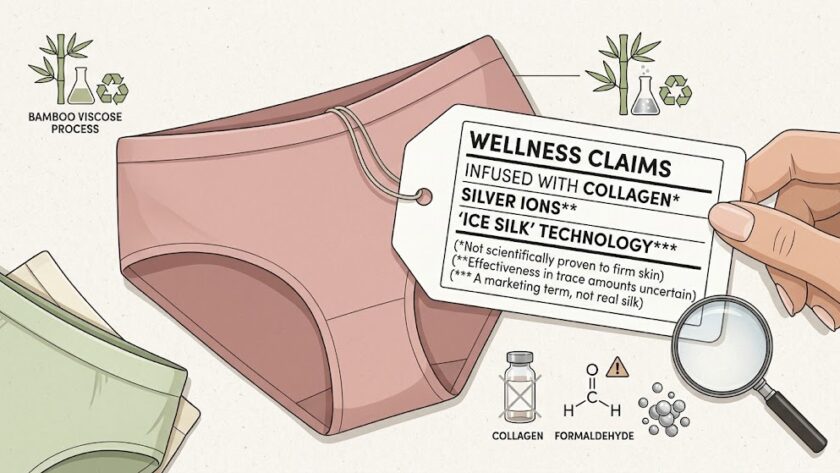
- “Ice Silk”: This is a marketing term, not an official fiber classification. In practice, it usually refers to thin, smooth synthetic fabrics made from nylon, polyester, or modal. While they may feel cool to the touch initially, they have nothing to do with real silk or any revolutionary cooling technology.
- Bamboo: Manufacturers love to highlight its “natural antibacterial properties” and eco-friendly origins. However, it’s worth knowing that most “bamboo underwear” on the market is actually bamboo viscose—a fiber produced through an intensive chemical process (similar to regular viscose) in which the natural structure of the plant is largely broken down and re-processed. Most claims regarding its superior antibacterial properties stem from the fabric suppliers’ own promotional materials rather than independent clinical trials—fitting the exact mechanism described by the RMIT researchers.
- Ionic Silver and Graphene: Both substances have real, scientifically proven antibacterial or conductive properties—but in laboratory settings, at specific concentrations and under controlled conditions. Transferring them into textiles in trace amounts, just enough to justify a buzzword on the tag, is a completely different story from achieving a measurable, hygienic effect during all-day wear.
This doesn’t mean that every single one of these technologies is a complete fabrication—it simply means that the application rate and method dictate whether it makes any tangible difference, something a product tag will never tell you.
What About the Chemicals Nobody Advertises?
Here lies one of the most ironic aspects of the whole issue: while brands compete to highlight “natural” and “active” ingredients, they rarely mention the chemical processing the new fabric undergoes in the factory. Studies published in the Indian Journal of Dermatology, Venereology and Leprology revealed the presence of formaldehyde (used to prevent wrinkling) in over half of the tested off-the-rack clothing samples—and dermatologists have long documented textile-induced contact dermatitis as a real, albeit underreported, issue. In other words: before believing the promise of „collagen in the tag,” it’s worth remembering that the actual chemistry in new underwear isn’t marketing-driven active ingredients, but rather resins and dyes that no one mentions in the product description.
How Not to Get Duped: Questions to Ask Before Buying
We don’t need to dismiss every item featuring an “enhanced” fabric out of hand—we just need to approach these claims with the same healthy skepticism we reserve for skincare or supplement labels. Before adding underwear with a “revolutionary ingredient” to my cart, I ask myself a few key questions:
- Does the product description state the exact percentage composition of the fabric, or just a vague marketing slogan without numbers?
- Does the manufacturer cite independent laboratory research or recognized certifications (e.g., OEKO-TEX), or merely internal testing?
- Is the claimed benefit (e.g., firming, antibacterial protection) physically possible through simple skin contact over a few hours of wear?
- Is the higher price justified by build quality (stitching, elasticity, durability), or is it driven by a trendy buzzword on the tag?
Summary
New textile technologies are not a myth—fibers can genuinely be more breathable, softer, or more durable than they were a decade ago. The problem starts when a modest, real-world innovation is wrapped in the vocabulary of a cosmetic laboratory to justify a markup and grab attention in overcrowded Instagram or TikTok feeds. As both academic analyses of “wellness-washing” and court cases involving shapewear or collagen cosmetics demonstrate, marketing—not science—is usually the first to seize upon these buzzwords. Meanwhile, the story of Ubras serves as a reminder that a brand built primarily on catchy slogans will eventually be called to account for what lies behind them. As consumers, we have every right to ask that same question—before, not after, we pay extra for a fancy label.
Sources
- Lynas E., Van Amber R., Luna Mora J., Fibre Fantasies: A Critical Examination of Wellness Claims in Textile Marketing, Fashion Highlight, Firenze University Press, 2024 – Link
- Boston University, Diet Plan: Wear Panties? (Legal case regarding Wacoal and Maidenform shapewear advertising) – Link
- Intertek, Collagen Fabric Testing – Link
- Tushnet R., Gunaratna v. Dennis Gross Cosmetology LLC – Legal analysis on the unauthorized use of the term “collagen” in advertising – Link
- Sixth Tone, ’Comfort First’ Bra Brand Backtracks After Sexist Ad – Link
- What’s on Weibo, Chinese Comedian Li Dan under Fire for Promoting Lingerie Brand with Sexist Slogan – Link
- Jing Daily, Chinese Lingerie Brand Ubras Comes Undone – Link
- Rao S., Shenoy S.D., Davis S., Nayak S., Detection of formaldehyde in textiles by chromotropic acid method, Indian Journal of Dermatology, Venereology and Leprology, 2004 – Link
This article is analytical and informational in nature. The brands mentioned serve as illustrative examples of broader marketing mechanisms documented in the cited sources and do not constitute an evaluation of specific products currently sold by them.